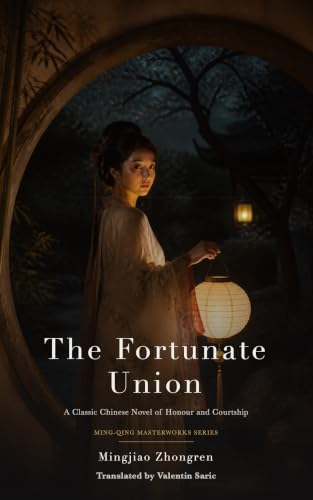
The Fortunate Union
A Classic Chinese Novel of Honour and Courtship (New Complete English Translation)
In 1761 this became the first Chinese novel Europe ever read. Here it is again,
complete, in modern English.
Thomas Percy's version travelled across eighteenth century Europe and was read
by Goethe, and for a long time it was the whole of what Western readers knew
about Chinese fiction. The book itself deserves better than a curiosity. It is
fast, funny, argumentative, and much stranger than its reputation.
About the Book
Tie Zhongyu is a young scholar so delicately handsome that his neighbours call
him Tie the Beauty, and the joke is in his surname, because Tie means iron and
his temper is the iron, not his face. He is generous to poor friends, freezing
to rich ones, and he will not marry, because a friendship can be ended and a
marriage cannot. When his outspoken father, a Censor at court, sends up one
memorial too many and is thrown into the prison of the Board of Punishments,
Tie rides for the capital. On the road he picks up the case that put his father
there, a licentiate's betrothed daughter carried off in daylight by a marquis,
and a young husband running for the Long Stream to drown himself because there
is no office in the empire that will hear him.
Shui Bingxin is his match and in places his superior. Left alone while her own
father is banished to the frontier, she outmanoeuvres the persistent Guo Qizu
three times over, by swapping a horoscope card, by walking into his trap and
walking straight out of it again, and by sending him home in triumph with a
sedan chair full of stones. When he counterfeits an imperial decree to take her
by force, Tie Zhongyu happens to be passing. Guo has him poisoned for it, and
she brings the dying stranger into her own house and nurses him there behind a
curtain, which saves his life and costs her her reputation for the rest of the
book.
What follows is stranger and better than any of it. A palace eunuch borrows an
imperial errand, two scrolls of plum blossom to be inscribed, and turns it into
a marriage trap, because plum and matchmaker sound alike. A bought censor
memorialises that the marriage is a defilement. And so the Emperor sends for
them both, questions them himself in the side hall, and settles by decree what
no court and no neighbour could settle. The wedding candles are lit three
times in this novel, and only the third lighting is real.
About This Edition
This new complete English translation presents all eighteen chapters, about
127,500 words, rendered directly from the Chinese text. Nothing is abridged or
moralised away. The argument scenes, the memorials and the imperial decrees are
kept at full length, and the poems and lyrics that open and close the chapters
are translated as verse. The Chinese text carries no chapter title couplets at
all, only bare chapter numbers, so the descriptive two part headings in this
edition have been supplied in English, in the register of a genuine chapter
couplet. Where Percy worked partly at a remove and through an incomplete
manuscript tradition, this edition follows the Chinese text throughout, with no
gaps and nothing cut short.
Themes and Legacy
The best known example of the scholar and beauty romance
A heroine who wins by strategy, evidence and nerve
Marriage, reputation and the price of being publicly right
Abuse of rank, forced marriage, and appeal to authority
Slander, official corruption, and what it costs to report the truth
The first Chinese novel translated into English, 1761, and a founding text of
European interest in Chinese literature
For Readers Who Love
Dream of the Red Chamber, Chinese Classical Fiction, Jane Austen,
Eighteenth Century Novels, World Literature in Translation
"Read in Europe before anyone there had read anything else from China."
At a glance
About the series
Rediscover the great epics, mysteries and chronicles of dynastic China: gods and generals, swindlers and scholars, courtesans, ghosts and emperors, in complete English translations.