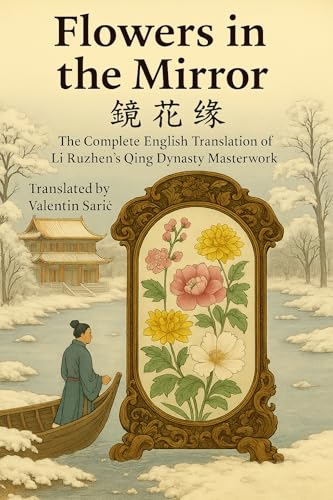
Flowers in the Mirror
The Complete English Translation of Li Ruzhen's Qing Dynasty Masterwork
“If flowers may bloom out of season at an empress’s command, what meaning has the natural order left?”
First published in 1827 and long celebrated as a cornerstone of Chinese fantasy literature, Li Ruzhen’s Flowers in the Mirror (鏡花緣) stands as one of the most imaginative and subversive novels of the Qing dynasty.
This monumental 100-chapter masterwork weaves together fantasy, satire, and erudition in ways few Western readers have ever experienced.
When the tyrannical Empress Wu Zetian commands all flowers to bloom simultaneously in winter, defying the laws of Heaven itself, the Fairy of a Hundred Flowers reluctantly obeys. For this transgression, she and her fellow flower spirits are banished to earth, reincarnated as talented young women across China and the strange lands beyond its borders.
What follows is an extraordinary journey: the scholar Tang Ao travels to bizarre kingdoms - the Country of Women where gender roles reverse completely, the Country of Gentlemen where virtue reigns supreme, lands of giants and pygmies - while his daughter Tang Xiaoshan and ninety-nine other reincarnated flower fairies demonstrate that women’s scholarship, courage, and wisdom rival any man’s.
Where other novels of its era relegated women to the margins, Li Ruzhen placed them at the center - as poets, warriors, philosophers, and heroes. Through wit, fantasy, and biting social commentary, he challenged foot-binding, educational inequality, and the suppression of female talent.
Now available in complete English translation, this edition restores all 100 chapters, allowing readers to experience the novel’s full scope - from its Gulliver’s Travels–like adventures through fantastical lands to its encyclopedic displays of Chinese arts, games, poetry, and classical learning.
This translation was produced through a trilingual translation process developed by Valentin Sarić, in which the original Classical Chinese was first translated into English, then refined through Croatian linguistic analysis, and finally re-rendered into polished literary English.
This method ensures faithful accuracy, cultural nuance, and poetic clarity - allowing the English text to retain both the rhythm of classical Chinese prose and the visionary brilliance of Li Ruzhen’s intent.
Ideal for:
- Readers of Romance of the Three Kingdoms, Journey to the West, and Dream of the Red Chamber
- Scholars and enthusiasts of Qing-dynasty literature and Chinese fantasy
- Students of feminist literary history and cross-cultural philosophy
- Anyone fascinated by imaginative world-building and proto-feminist thought
Li Ruzhen (李汝珍, c. 1763–1830) was a Qing-dynasty polymath - novelist, phonologist, mathematician, and scholar - from Beijing. Frustrated by his failure in the imperial examinations, he channeled fifteen years of erudition and imagination into Flowers in the Mirror, creating a novel that doubled as an encyclopedia of Chinese arts and sciences. His defense of women’s education and intellect was centuries ahead of its time, and his critique of inequality remains strikingly relevant today.
This edition presents Flowers in the Mirror as both literature and cultural revolution - bridging centuries between Li Ruzhen’s visionary world and the modern reader’s search for wonder, justice, and the full recognition of human potential.
At a glance
About the series
Rediscover the great epics, mysteries and chronicles of dynastic China: gods and generals, swindlers and scholars, courtesans, ghosts and emperors, in complete English translations.