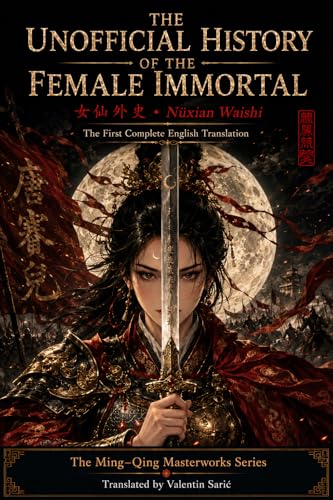
The Unofficial History of the Female Immortal
The First Complete English Translation
Once banned. Once burned. Now restored in full.
About the Book
When the Yongle Emperor seized the throne of his murdered nephew, the official histories recorded the woman who rose against him as a sorceress and a criminal. Lü Xiong's Nüxian Waishi tells her story another way - as the chronicle of a goddess in exile, come to earth to set right a usurpation that shook Heaven itself.
In this sweeping hundred-chapter epic of the early Qing, the historical rebel Tang Sai'er is revealed as the Moon Goddess Chang'e, descended to the mortal world to wage war on the Heavenly Wolf - the star-spirit reborn as the usurper Zhu Di. Around her gather immortals, sword-maidens, and loyal generals; against her stand the armies of an empire and the magic of its servants. What begins as one woman's uprising in Shandong becomes a struggle that reaches from the battlefields of the Jingnan campaign to the courts of the gods.
Bold in conception and unmistakably subversive - it set out to overturn the verdict of the official record and place a woman at the center of the cosmos - the novel so unsettled the Qing authorities that it was condemned as licentious and consigned to the lists of destroyed books. It survived in the margins, treasured by the few, and now appears complete in English for the first time.
This edition restores all one hundred chapters: part historical romance, part supernatural war-epic, part argument with history over who deserves to be remembered, and how.
Themes & Legacy
- The Jingnan usurpation retold from the side of the defeated
- A female immortal at the heart of a martial and cosmic epic
- Rebellion as loyalty: the question of who truly serves the rightful throne
- A banned book's defense of a woman the histories tried to erase
For readers who love Flowers in the Mirror • Investiture of the Gods • Journey to the West • The Water Margin • Mulan
At a glance
About the series
Rediscover the great epics, mysteries and chronicles of dynastic China: gods and generals, swindlers and scholars, courtesans, ghosts and emperors, in complete English translations.