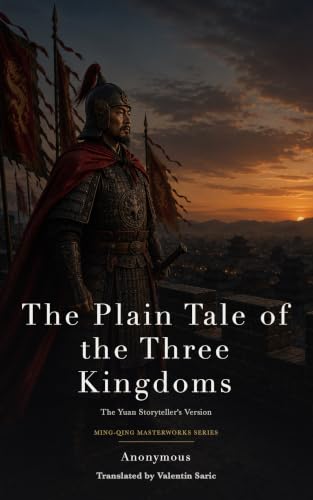
The Plain Tale of the Three Kingdoms
This is the book that the Romance of the Three Kingdoms was made out of.
About the Book
Before Luo Guanzhong, before the hundred and twenty chapters, before the
polished dialogue that every reader in East Asia can quote, there was this: a
short, blunt, fast moving printed storyteller's script from the Yuan dynasty,
issued in three volumes with pictures across the top of every page.
Everything you recognise is here in rough form. Liu Bei, Guan Yu and Zhang Fei.
The Yellow Turbans. Lu Bu and Diaochan. Cao Cao. Zhuge Liang taking Sichuan
fortress by fortress. Zhou Yu at the Yellow Crane Tower, drunk, waking to find
that Liu Bei has walked out of his trap and gone down to the boats, smashing his
own zither and sending Gan Ning and Ling Tong after him with three thousand men,
and Zhang Fei standing on the bank so that not one of them dares to land. The
death of Zhuge Liang and the dead Zhuge Liang who still routs a living Sima Yi.
And then there is everything you do not recognise, which is why the book
matters. This Zhang Fei beats the inspecting official to death with his own
hands instead of merely thrashing him. He takes to the hills as a bandit, styles
himself the Surnameless King and proclaims his own reign period, the Happy
Years. The oath of brotherhood, the strategies, the moral weighting, all of it
sits differently. Names are different: the Sichuan commander here is Zhang Yi of
Ziwu city, the Iron Arm General. The narrative jumps, compresses whole campaigns
into a sentence, and then slows down for a single trick or a single insult.
This is popular narrative before it became a classic. It is the version people
actually heard.
About This Edition
This English translation presents the pinghua complete, in its original three
volume shape.
The text has no division into hui, no numbered chapters and no chapter couplets;
those arrived later with the Ming novel. The three volumes are the whole work
and they are given as they stand, with volume breaks marked and no chapter
scheme imposed on them. At roughly a fifteenth of the length of the Romance,
this is a book a reader can finish in an evening and then spend a year thinking
about.
Where the pinghua diverges from the familiar Romance, the divergence is left
alone and noted, not corrected. That is the whole value of the text.
Themes and Legacy
- The direct source and skeleton of Romance of the Three Kingdoms
- Yuan dynasty popular storytelling in printed form
- A rougher, wilder, more folkloric Zhang Fei and Liu Bei
- How a national epic looked before it was made respectable
- Essential reading for anyone who has read the Romance
For Readers Who Love
Romance of the Three Kingdoms / Three Kingdoms history / Chinese oral and
popular literature / Yuan dynasty texts / Comparative and source studies
"Read the Romance. Then read the thing the Romance was cut from."
At a glance
About the series
Rediscover the great epics, mysteries and chronicles of dynastic China: gods and generals, swindlers and scholars, courtesans, ghosts and emperors, in complete English translations.